
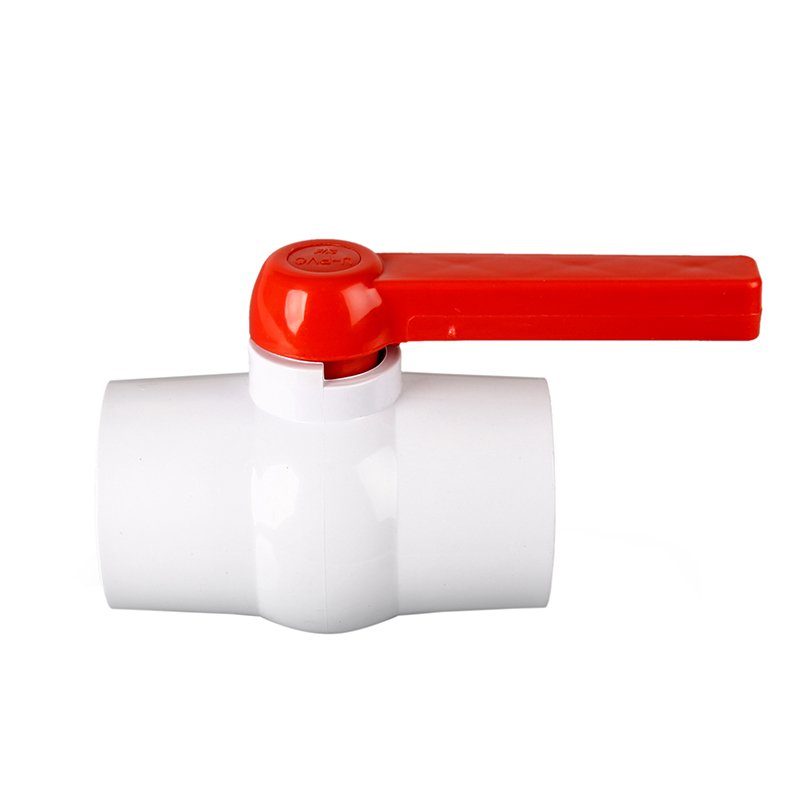
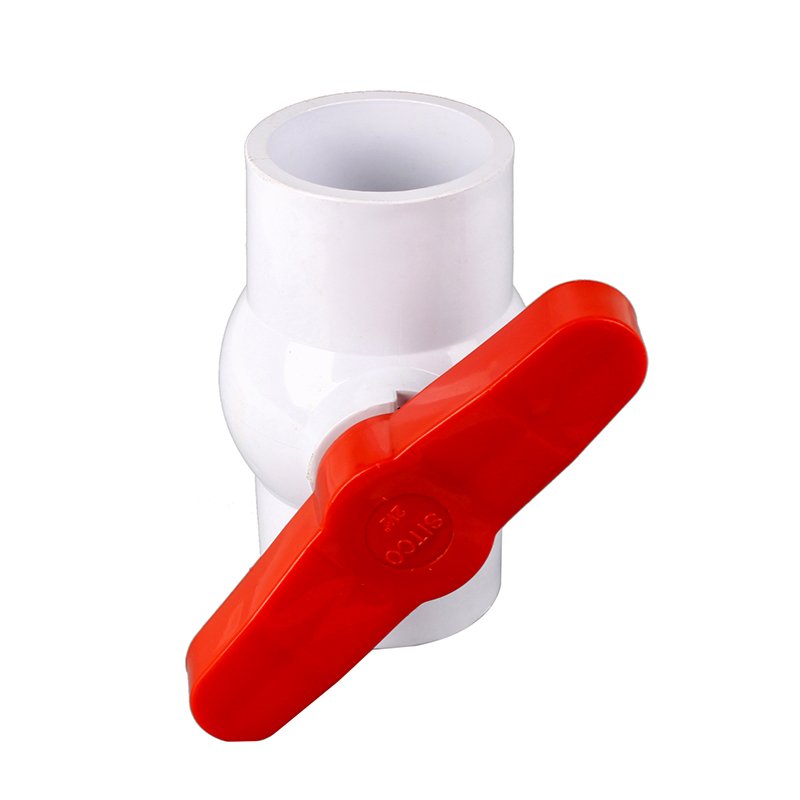
When it comes to building a reliable, long-term water distribution system—whether it’s for a municipal park or a massive agricultural drip network—the connection method is the foundation of success. For most permanent PVC piping, the socket end pvc ball valve (also known as a slip or solvent-weld valve) is the industry standard.
Unlike threaded options, a pvc ball valve with socket ends creates a chemical bond between the pipe and the valve, effectively turning the two components into a single, seamless piece of plastic. As a factory-integrated leader with 17 years of expertise, HONGKE (Zhejiang Hongke Valve Co., Ltd.) understands that the precision of that socket determines the integrity of your entire system.
1. Why Choose Socket (Slip) Connections?
The primary reason professionals reach for a socket end pvc ball valve is reliability. In outdoor water systems, vibration, thermal expansion, and soil movement can cause threaded joints to weep over time. A solvent-welded socket connection, however, is virtually leak-proof.
Key Advantages:
- Permanent Bonding: The solvent cement “cold welds” the materials together.
- Flow Efficiency: Without threads protruding into the flow path, internal turbulence is minimized.
- Cost-Effectiveness: Socket valves are often more affordable than union or threaded counterparts, making the socket end pvc ball valve price highly attractive for high-volume B2B procurement.
2. Technical Specifications: Finding Your Perfect Match
A successful installation starts with the right dimensions. Whether you are installing a specialized 1/2 inch socket pvc ball valve for a branch line or a 2-inch valve for a main header, the tolerance of the socket depth is critical.
| Size (Inches/mm) | Socket Depth (Standard) | Recommended Application |
| 1/2″ (20mm) | 16mm – 19mm | Drip irrigation & residential repair |
| 3/4″ (25mm) | 19mm – 22mm | Garden sprinklers & greenhouse lines |
| 1″ (32mm) | 22mm – 26mm | Secondary water distribution |
| 1-1/2″ (50mm) | 31mm – 35mm | Commercial landscaping main lines |
| 2″ (63mm) | 38mm – 42mm | Agricultural pump discharge |
3. Installation Mastery: Ensuring a Leak-Free Joint
To get the most out of your pvc ball valve with socket ends, follow these professional installation steps:
- Preparation: Cut the pipe square and remove all burrs. A smooth edge prevents the solvent from being pushed to the bottom of the socket.
- Dry Fit: Insert the pipe into the socket without glue. It should go in about 1/3 to 2/3 of the way. If it’s too loose or won’t enter, do not proceed.
- Apply Solvent: Use a high-quality PVC primer and cement. Apply a thin layer to the valve socket and a generous layer to the pipe end.
- The Quarter-Turn: Push the pipe into the socket until it bottoms out, then give it a 1/4 turn to evenly distribute the cement.
- Set Time: Hold the joint firmly for 30 seconds. Allow at least 15-30 minutes of curing time before moving the pipe, and 24 hours before full pressure testing.
4. Why Partner with HONGKE for Your Socket Valve Supply?
When your project requires thousands of valves, you need a socket end pvc ball valve price that fits your budget and a quality standard that protects your reputation.
Precision Molding
At HONGKE, we utilize high-precision molds to ensure our socket diameters are consistent to within microns. This means your installers won’t struggle with “too tight” or “too loose” fittings in the field, reducing labor time and waste.
Wholesale Scalability (3000 PCS MOQ)
We are built for the B2B backbone. Our 3000 PCS MOQ per size allows us to maintain a dedicated, automated production line. For distributors and large-scale contractors, this guarantees that every valve—from the first to the 3,000th—meets our 1.0-1.6MPa pressure rating.
Factory-Direct Integrity
As an Industry and Trade Integrated manufacturer, we offer nearly two decades of expertise. We provide the technical documentation, UV-stabilized materials, and the factory-direct pricing that trading companies simply cannot match.
Conclusion: Build Better with HONGKE
The socket end pvc ball valve is the quiet hero of the irrigation and plumbing world. By choosing a manufacturer that prioritizes dimensional accuracy and material purity, you ensure your water system remains leak-free for years to come.
Partner with HONGKE for your high-volume valve needs and experience the difference that 17 years of manufacturing excellence makes.
Ready to secure your project with high-precision socket valves?
[Contact HONGKE Today for a Wholesale Quote & Technical Data]
People Also Ask (FAQ)
Q: Can I use a socket end pvc ball valve with threaded pipe? A: No directly. You would need a “Male Adapter” to transition from the threaded pipe to a socket connection. For the most reliable system, it is best to match your valve type to your piping style.
Q: What is the average socket end pvc ball valve price for bulk orders? A: Prices vary based on size (e.g., a 1/2 inch socket pvc ball valve vs. a 2-inch model) and material grade. As a factory-direct supplier, HONGKE offers competitive wholesale pricing for orders meeting our 3000 PCS MOQ. Contact us for a specific quote.
Q: Is solvent welding stronger than a threaded connection? A: In most PVC applications, yes. A solvent-welded joint becomes a chemical bond that is often stronger than the pipe itself, making it the preferred choice for permanent, underground, or high-vibration environments.
Q: How long should I wait after gluing before turning on the water? A: For low-pressure irrigation, you can often test after 2-4 hours. However, for systems running at the full 150 PSI (1.0 MPa) rating, we strictly recommend a 24-hour cure time to ensure the chemical bond is fully set.